

Owing to the harsh climate and the large amount of precipitation, the Egge has never been a preferred area for human dwelling. However, this has not precluded certain forms of land-use. Wood from the beech forests formed the basis for glassworks: it was needed for potash production and for heating the ovens. The demand for fuel was enormous: the production of 1 kg of glass consumed approx. 1 cubic metre of wood. A single glassworks needed up to 5,000 cubic metres of timber, corresponding to 20-30 ha of forest. For this reason, glassworks were established directly in the forests.
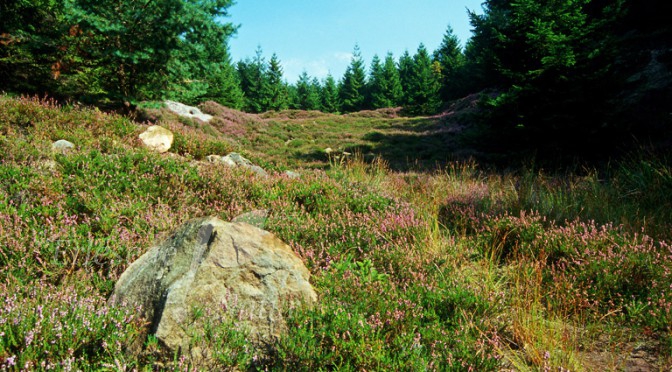
Once the supply of wood was exhausted, production moved on. The remaining, largely devastated, forests were used us summer pastures for livestock by the surrounding villages. The continuous grazing of the acidic and nutrient-poor soils led to the development of extensive upland heaths to the west of the Egge. A good example of this landscape type is still visible at the Velmerstot near Steinheim-Sandebeck.
During the 19th and 20th centuries, forests were restored on the upland heaths. However, reafforestation was possible only with the undemanding spruce. This is why the spruce, which is not normally a native tree of the region, is so common here. A totally different situation prevails on the steeper slopes of the eastern Egge: on mostly calcareous soils, the original beech forests remain until today.