

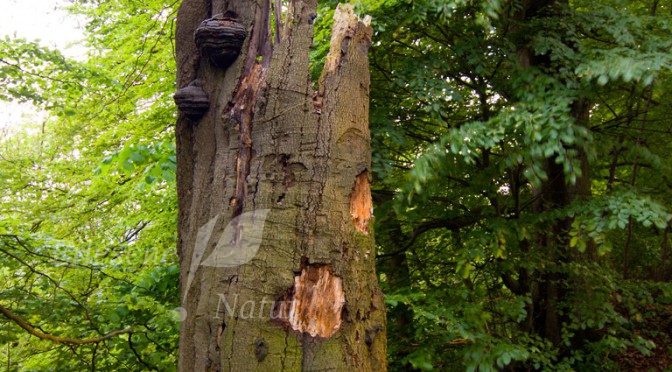
Many forest trees are blessed with a long lifespan: for instance, beeches can live for 300 years or up to a maximum of 400 years. But in modern forests you will hardly find trees of that age because beeches are usually harvested at 120 to 140 years. In pristine forests the situation is totally diferent: ancient and dead trees (“snags”) are typical components. They play an important role for the forest, since they constitute the habitat and food of a multitude of animals and fungi.
Fungi and bacteria are responsible for the decomposition of very hard organic material, such as lignin. By this process, wood is transferred back into the nutrient cycle. A typical decomposing fungus is the tinder fungus, with its perennial fruiting bodies. These fungi exhibit what is known as geotropism: this means that the undersides of new fruiting bodies are always aligned towards the ground. Once the inhabited tree falls, new bodies grow in a rectangular direction to the old ones.
In order to facilitate the survival of species specialising on old-growth or coarse woody debris in commercially managed forests, trees are deliberately selected to remain in the stands as so-called “Methusalems”. Furthermore, large snags in warm microclimatic conditions are a prerequisite for the existence of several large and highly endangered beetles, like the stag beetle, the great capricorn beetle or the hermit beetle. Their larvae spend many years in the dead tree, feeding on decomposing wood.